
Build a Beautiful Texas Lawn with Professional Advice
Fast Facts:
- Fertilization should be complemented. Mowing, watering, and soil testing enhances your lawn care results.
- Pay attention to your grass type. Warm-season grasses in Dallas (Bermuda, Zoysia, St. Augustine) need the most attention in the window between late spring and early fall.
- Timing is the most important factor. Soil temperature is the most accurate way to determine when to fertilize your lawn.
- You can overfertilize. Using too much fertilizer will burn the grass, build up thatch, and create runoff.
- Homeowners in the Dallas metroplex should contact GroGreen for expert fertilization and lawn care!
Soil Temperature Matters Most
When it comes to fertilization timing for a lawn treatment, don’t think in terms of the calendar. Think about the soil temperature.
Grass roots begin drawing in nutrients at around 65°F. Below that, product either breaks down without being used or washes away with the next rain. For DFW’s warm-season grasses, the productive range runs higher (between 70 and 85°F), which is when these varieties are active and growing.
A soil thermometer costs a few dollars at your local store. Push it three to four inches into the ground and read it. Most DFW homeowners who do this for the first time find that their instinct about when the growing season starts runs weeks ahead of when the soil is actually ready.
If you’d rather skip the thermometer, the lawn itself shows you when it’s ready. When grass transitions from its flat winter color to actively green and starts pushing enough new growth to need its first mow, conditions are right.
What Does Fertilizer Actually Do?
Fertilizer delivers three nutrients, each serving a different function:
- Nitrogen drives blade growth and produces the deep green color that registers as a healthy lawn. It’s the most visually impactful of the three and the one most likely to cause burn when overapplied.
- Phosphorus works underground, supporting root development and the energy transfer that keeps grass strong through DFW’s brutal summer.
- Potassium builds cell wall strength and disease resistance, so your lawn holds up under stress over the long run.
When all three are available at the right time, the effects multiply. Density increases, color becomes more consistent, and the turf builds enough competitive strength to push back against weeds naturally.
A deeper root system also pulls moisture from further down in the soil. The bonus? A well-fed lawn needs less irrigation than one that’s been neglected.
However, more doesn’t equal better.
For instance, heavy nitrogen at the wrong moment burns grass within days. Applications just before significant rain wash product into storm drains before the soil absorbs anything. And forced growth during heat stress produces grass that collapses. The goal is feeding the lawn in sync with its growth cycle, not pushing against it.
How Often Does a DFW Lawn Need Fertilizing?
Two to four applications a year covers most situations. A twice-yearly program hitting the two highest-value windows (late spring and early fall) maintains a reasonably healthy lawn. A four-application seasonal schedule produces noticeably better results for homeowners who want genuinely dense, resilient turf.
Three variables determine where your lawn falls in that range:
Soil type
Clay soils common across much of DFW hold nutrients reasonably well but can develop drainage and compaction issues that limit how effectively those nutrients reach grass roots.
Sandier soils in parts of North Texas shed nutrients faster. These benefit from more frequent, lighter applications.
Fertilizer type
Slow-release granular formulas break down gradually over six to eight weeks, feeding the lawn steadily and requiring less frequent reapplication.
Quick-release products work faster but deplete faster. So they’re useful for correcting specific deficiencies but less forgiving on timing and application rate.
Grass type
Bermuda, Zoysia, and St. Augustine have long active growing windows in DFW’s climate. They’re genuinely hungry for nutrients across late spring and summer.
Cool-season grasses, far less common on DFW lawns, concentrate their nutritional needs in fall and early spring and should be scheduled completely differently.
A Seasonal Schedule for North Texas
Early Spring
When soil temperatures are climbing toward 65°F and the grass is visibly breaking dormancy, a light early spring application supports root development at the moment the plant is prioritizing underground recovery. Light is the key word there. Heavy nitrogen at this stage pushes rapid blade growth before the root system is ready to support it. The result would be top-heavy grass that underperforms the rest of the season.
If the soil is still cold or the lawn hasn’t started growing, skip this application entirely. There’s no benefit to fertilizing grass that isn’t in a position to use it.
Late Spring
Five to eight weeks after the early spring application, a late spring feeding helps when warm-season grasses are growing most aggressively. It’ll build density, fill thin areas, and compete against summer weeds.
A nitrogen-focused fertilizer drives the visible response here. This is also the window where a combined fertilizer and pre-emergent weed control product makes sense if crabgrass or other weeds have been a recurring problem.
Summer
DFW summers push warm-season grasses hard. Summer fertilization is about sustaining what the lawn has built, not forcing additional growth the plant can’t support at 100°F.
A light slow-release application keeps nutrients available without the stress spike that quick-release nitrogen would cause under heat. If Bermuda goes semi-dormant during an extended dry stretch, hold off on feeding until active growth resumes.
Fall
A fall fertilizer feeding builds the root reserves and carbohydrate storage that carry warm-season grasses through winter. It also helps your lawn green up in spring. Because the grass at this point is investing underground rather than in blade growth.
Apply in early fall while soil is still warm enough for active uptake. A second application six to eight weeks later completes a full program. Just make sure you stop before the first frost.
Common Lawn Fertilizer Mistakes
These four mistakes account for most of the disappointing results homeowners see after putting in real effort:
- Fertilizing too early. The urge to get started when late February feels warm is understandable. But DFW soil usually isn’t ready by then. Checking soil temperature before the first spring application costs two minutes and eliminates this mistake entirely.
- Overapplying quick-release nitrogen. Burn shows up as yellowing or browning within days and takes weeks to recover from. When the recommended application rate feels conservative, use it anyway. Slightly under-feeding is better than slightly over-feeding.
- Applying before rain. A light rain after application is helpful. A downpour before it absorbs sends product into storm drains and accomplishes nothing. Check the forecast with a few hours of buffer before you start spreading.
- Ignoring grass type. A summer nitrogen application on cool-season fescue during a DFW heat wave stresses it. Knowing what you’re growing shapes every timing decision that follows.
Helpful Tips to Get the Application Right
A few application habits make a consistent difference regardless of product:
- Mow one to two days before spreading fertilizer so granules reach the soil surface rather than sitting on top of long grass
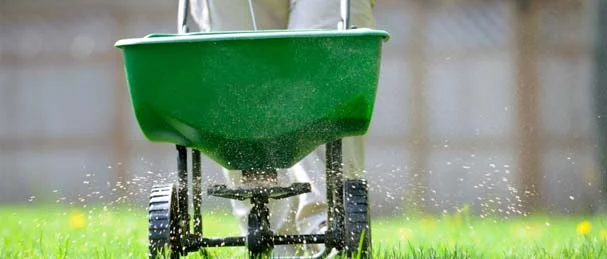
- Use a broadcast spreader for open lawn areas and a drop spreader near garden beds, water features, or property edges where overspray creates problems
- Overlap passes slightly since skipped strips show up within a week as faint light green lines through an otherwise even lawn
- Water lightly after applying granular fertilizer to move product off the blades and into the soil
- Sweep any granules off driveways and sidewalks before watering
3 Things That Help Your Fertilization Strategy
A few complementary habits amplify the results the same product produces:
Leave grass clippings on the lawn. A mulching mower returns nitrogen to the soil throughout the growing season at no cost. It’s a low-level background fertilizer application built into your regular mowing routine.
Water deeply and infrequently. Shallow daily watering keeps roots near the surface where they access nutrients from a small soil volume.
Deep, infrequent irrigation builds the root depth that pulls from a much larger area. This makes each fertilizer application go further without changing anything about the product or rate.
Soil test every two to three years. DFW’s clay soils can develop pH and nutrient imbalances, so fertilizer can actually be less effective even when timing and rates are correct. A basic soil test reveals what’s actually happening below the surface and turns a general schedule into one calibrated to your specific yard.
How Old Is Your Lawn?
The approach shifts meaningfully depending on where your lawn is in its life cycle.
For new seeded areas: Apply a starter fertilizer at or just before planting. Starter formulas are phosphorus-heavy because new grass needs root establishment above everything else. With new sod, wait two to three weeks for roots to begin anchoring before fertilizing.
Keep weed control products away from new lawns. Pre-emergent herbicides prevent germination of anything, including your grass seed. Post-emergent products stress young turf enough to set back establishment. Wait until you’ve completed two or three mowing cycles before introducing any herbicide.
For established lawns: Follow the seasonal schedule and adjust based on what you’re observing. Growth rate, color consistency, and how the lawn responded to the last application all carry useful information about what to do differently next time.
Questions DFW Homeowners Ask Most Often
-
Can you fertilize too much?
Absolutely. Burned turf, thatch buildup, and nutrient runoff are all common consequences.
-
Is it better to fertilize before or after rain?
Apply it to dry grass and water lightly afterward. Heavy rain before the product absorbs washes it away.
-
Should I fertilize if the lawn looks green?
Color isn’t everything. Growth rate, density, and performance under stress tell you more about whether the lawn is well-nourished.
-
What month is best for DFW lawns?
Late May and early September are the two highest-return windows for Bermuda, Zoysia, and St. Augustine. If you’re fertilizing twice a year, build your schedule around those two dates.
Professional Lawn Care Produces Consistent Results
Running a fertilization program across an entire season requires constant attention to timing, product selection, application rates, and grass-specific scheduling. Done well, the results are visible. Done inconsistently, the lawn stays mediocre regardless of how much effort goes in.
GroGreen builds fertilization programs around the actual conditions of your yard rather than a generic schedule. Our technicians also handle aeration, soil amendments, and broader lawn care tailored to North Texas turf.
GroGreen serves these Dallas-Fort Worth communities:
Addison | Allen | Anna | Aubrey | Balch Springs | Carrollton | Cedar Hill | Celina | Coppell | Dallas | Desoto | Duncanville | Flower Mound | Frisco | Garland | Grand Prairie | Hutchins | Irving | Lancaster | Lavon | Lewisville | Little Elm | McKinney | Melissa | Mesquite | Nevada | Plano | Princeton | Prosper | Richardson | Rockwall | Rowlett | Sachse | Seagoville | Sunnyvale | The Colony | Wilmer | Wylie | Murphy | Parker | Lucas | Fairview | St Paul | Hebron | Lowry Crossing
Blog Contributor: James Duhon
James Duhon serves as Branch and Area Manager for GroGreen in Plano, with 20 years of experience. He is licensed by the Texas Department of Agriculture for both lawn care and structural pest control. His background gives him a strong perspective on service standards, customer satisfaction, team leadership, and practical lawn and pest care expertise.